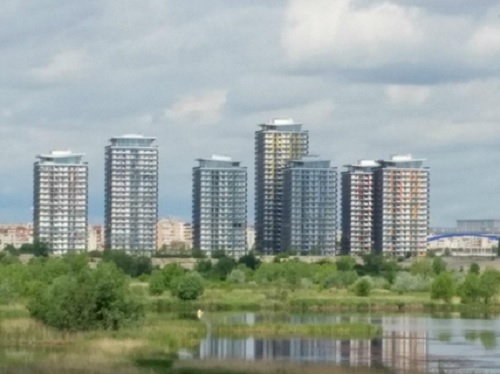
The survey was based on executives from local, regional, and international investors and developers, managing portfolios with a total value exceeding €15 billion, representing approximately 50% of Romania’s modern real estate market.
Office Sector Remains Resilient
The office sector continues to show resilience, with 56% of respondents expecting rental growth over the next 12 months and 39% anticipating stability. Only 5% foresee a decline, confirming long-term confidence in market fundamentals despite changes brought about by hybrid working models. Demand for new spaces remains steady, as many tenants prefer to restructure existing premises rather than expand, leading the market into a phase of maturation.
Industrial / Logistics Sector Stabilizing
Following a period of strong optimism in 2022–2023, when rental growth expectations peaked at 75%, the industrial and logistics sector now shows signs of stabilization. In the latest survey, 52% of participants expect stable rents, 36% anticipate further increases, and 12% predict a decline, reflecting a more balanced market.
Moderate Optimism in Retail
Expectations in the retail sector are mildly positive. Forty-one percent of respondents foresee rental growth, nearly half (49%) expect stability, and only 10% anticipate a decrease. This reflects a post-pandemic normalization phase, supported by steady consumer demand. Fiscal changes are identified as the most significant factor affecting property costs (20%), followed by geopolitical developments and macroeconomic uncertainty (18% each). Inflation (17%) and interest rates (13%) also play an important role.
Investment Preferences and Outlook
Industrial and logistics properties remain the top investment choice, although growing interest is observed in alternative sectors such as hotels and residential real estate (PRS and PBSA). Offices are showing signs of gradual recovery, while retail maintains moderate momentum. Bucharest continues to be the primary investment destination, with 72% of investors naming it as their top choice. Interest in secondary and tertiary cities is also rising, with 68% considering secondary markets attractive and 34% actively targeting cities with fewer than 200,000 inhabitants.
For 2026, 56% of investors plan to expand their portfolios, 35% intend to maintain their current positions, and only 9% anticipate reducing activity. Although the appetite for expansion has moderated compared to previous years, the overall sentiment remains positive. Banks are the main source of financing for 34% of investors, while equity and shareholder loans play an important role (21% each).
Finally, despite challenges, most companies expect the value of their portfolios to remain stable over the next 12 months. The market is supported by cumulative transactions exceeding €8 billion since 2016, as well as a development pipeline of over 800,000 sqm in offices, logistics, and retail for the next two years.