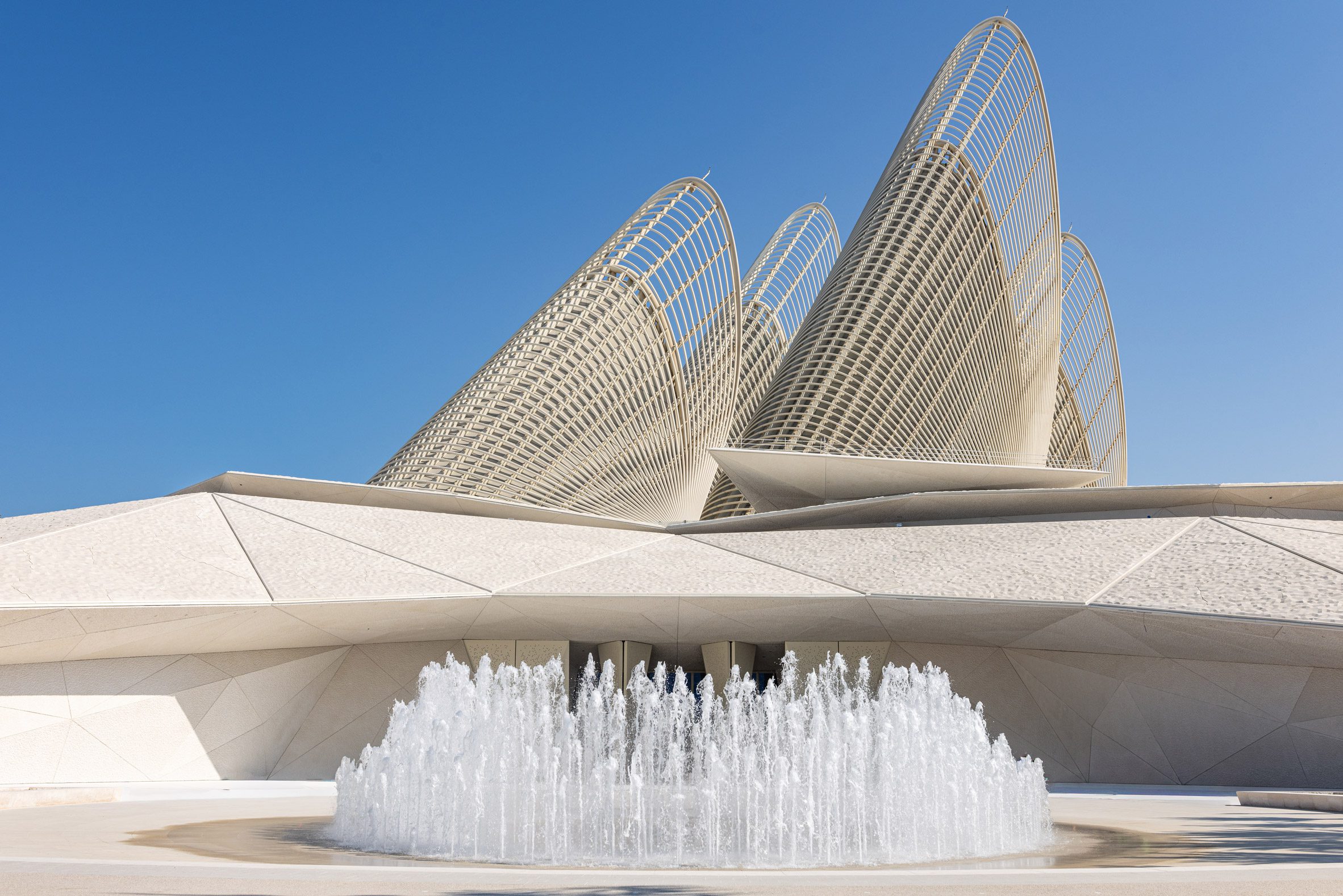
The highly anticipated project now stands as the architectural centerpiece of a district that already includes Jean Nouvel’s Louvre Abu Dhabi and Frank Gehry’s under-development Guggenheim Abu Dhabi. Dedicated to the founder of the United Arab Emirates, Sheikh Zayed bin Sultan Al Nahyan, the museum presents the history, culture, and landscape of the Emirates across seven thematic galleries.
“Zayed National Museum is at the heart of the Saadiyat Cultural District, a new cultural zone along the coastline,” Norman Foster told Dezeen.
The museum’s location, set further inland on the island, is directly connected to the coast via Al Masar Garden, while surrounding areas are being developed with new commercial and residential zones, creating a “small city within the city,” Foster added. The building spans 88,870 square meters and is defined by its five enormous steel towers, which allow cool air to flow into the interior.
Architectural Inspiration
Each tower has a distinct shape and height, with the tallest reaching 123 meters. They are positioned to allow natural light to enter through their glass surfaces. Architecturally, the towers evoke the wings of a falcon—a tribute to Sheikh Zayed’s love of the bird.
The “winged” towers harness aerodynamics to create natural airflow. “The tips of the towers are heated by the sun, generating upward thermal currents that draw cool air from the building’s subterranean levels,” Foster explained. This is a passive cooling technology ideally suited to the desert climate.
The museum is “embraced” by a sculptural elevated form—a polyhedral mound reminiscent of desert topography. This exterior shell contributes to natural cooling while incorporating public spaces, shaded pathways, and a viewing platform.
The building’s primary material is white concrete made from locally crushed marble, reflecting the color of Saadiyat’s sand. The concrete is combined with patinated bronze for signage and gallery entrances, as well as painted steel and aluminum in the towers.
Inside, curved cylindrical concrete walls form the Al Liwan lobby, an impressive space housing a shop and an auditorium.
Two permanent galleries are located at the lobby level, while four additional galleries hover on the first floor as separate “capsules” suspended from the cylindrical walls. These pods, clad in glass-fiber-reinforced concrete panels, create gaps through which natural light from the towers diffuses into the central space. The gallery sizes vary according to their themes, offering, according to Foster, a “deliberate shift in scale” as visitors move through the museum.